A–z Basic print
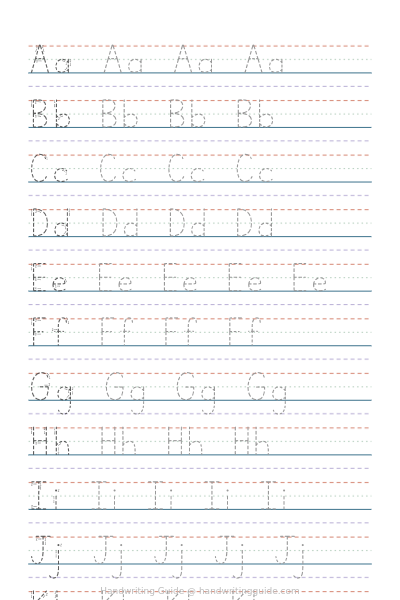
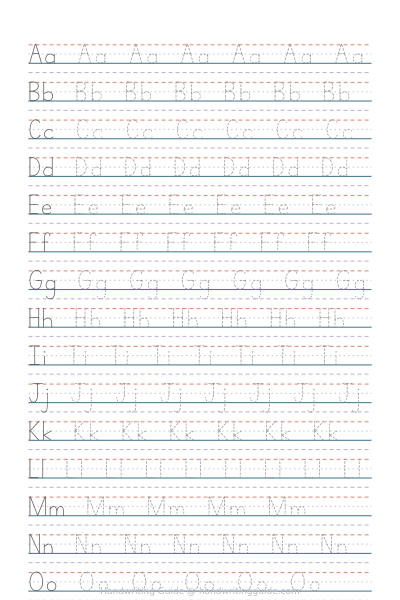
All 26 uppercase and lowercase upright print letters on four-line guides. One letter per row with tracing.
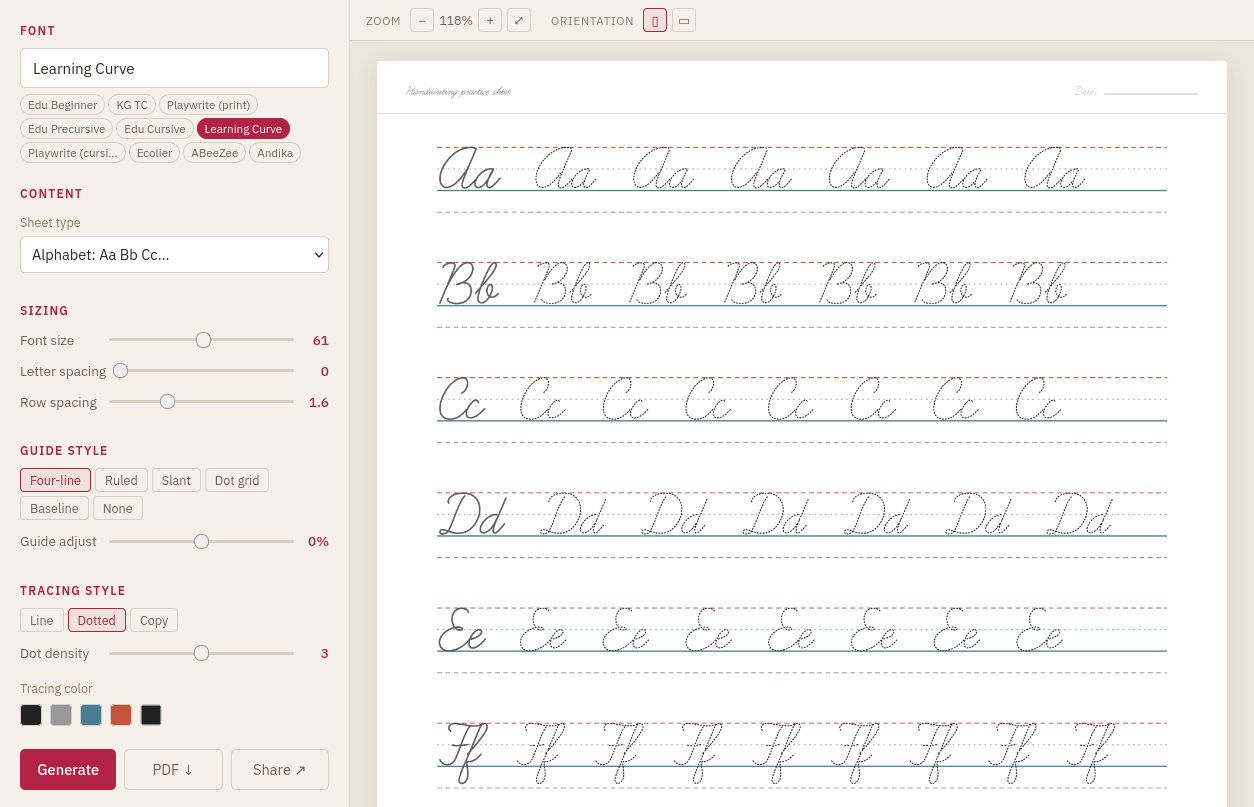
Pick a font, enter your text, and generate a clean, structured practice sheet in seconds. Tracing guides, line styles and spacing all under your control. No account, no watermark.
Start with a sentence, the alphabet, or your own text.
In an age of keyboards, handwriting has become a deliberate act, which is precisely what makes it valuable. Research consistently finds that writing by hand deepens comprehension, aids memory, and cultivates a quality of attention that typing rarely produces.
This site exists for people who take that seriously. Whether you are a teacher preparing worksheets, a bullet journaler chasing cleaner headers, or an adult improving a hand you were never properly taught, the practice is the same: slow, intentional and repeated.
The generator makes that practice frictionless. Everything else here is designed to make it meaningful.
Ten focused minutes a day beats an hour of unfocused copying.
See how in the 10-minute daily routine →Select from a list of curated fonts or choose any Google font. Enter any text: a sentence, the alphabet, a poem. Adjust line spacing and tracing style to match your level.
Open generatorEvery sheet exports as a perfectly formatted A4 or Letter PDF. Print at home, at school, or at a library. No account, no watermark, no cost.
See sample sheetsPair your sheets with our improvement guides covering grip, posture, letter formation, and daily routines that build lasting change.
Read the guidesFrom first print letters to flowing joined cursive to decorative lettering for journals and cards. Sheets and guides for every stage and every style.
Explore cursiveImprove a hand you were never properly taught. Structured practice for grip, consistency, and personal style. All resources for adults
Develop formal scripts and letterform precision with slant guides, wide spacing, and fonts built for deliberate, structured practice. All calligraphy resources
Develop a cleaner, more intentional hand for spreads, headers and everyday notes. Resources for journalers · Bujo fonts & lettering styles · Bullet journal worksheet collection
Printable sheets for children at every stage; from first letters to confident, fluent handwriting. All resources for parents
Generate custom worksheets in seconds. Enter your own text, match your curriculum, print for the whole class. Resources for teachers · Teacher worksheet collection
Flexible resources that fit any curriculum; from first letters to full cursive fluency. All homeschool resources
There is no point practising a formal italic if your goal is fast, legible everyday notes. Choose the model that matches the destination: the font you practise from is the hand you will end up with.
Choose from hundreds of handwriting fonts, set your tracing style, adjust line spacing, and enter any text you like. Download as a perfectly formatted PDF ready to print. Pick up a pen and start your practice.
Open the GeneratorAll 26 uppercase and lowercase upright print letters on four-line guides. One letter per row with tracing.
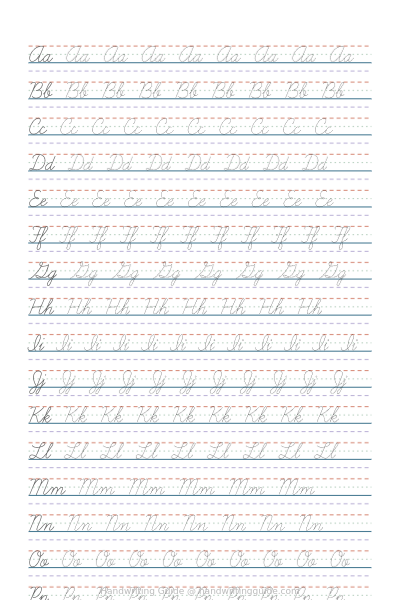
All 26 uppercase and lowercase cursive letters on four-line guides. One letter per row with dotted tracing.
All 26 uppercase and lowercase print letters with arrows indicating stroke order, on four-line guides. Oversized letters, great for new learners of any age. One letter per row with tracing.
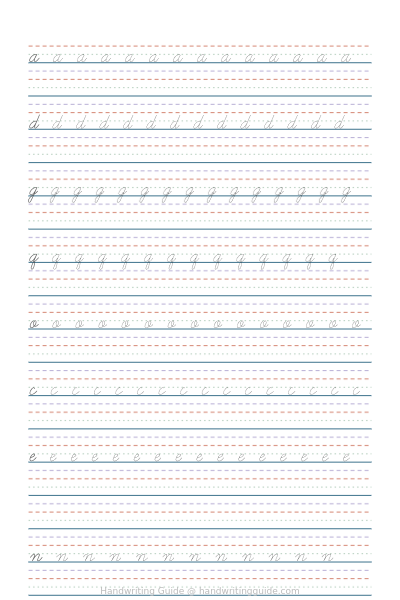
Cursive letters grouped by shared stroke shapes on four-line guides. Each group includes dotted tracing rows followed by empty guided lines for copy practice.
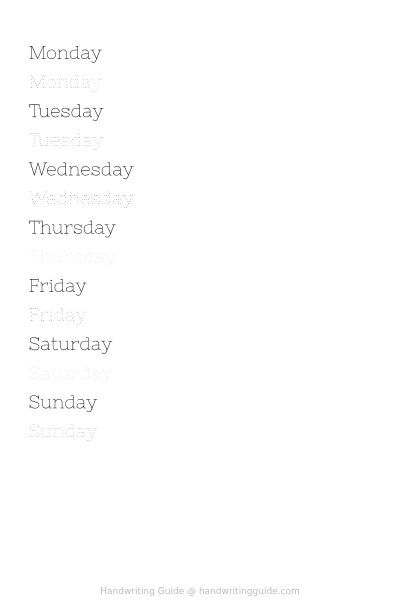
Weekdays with dotted grid, for bulletjournalers. A clean, minimalist monoline handwriting font that looks like neat fineliner lettering in the bullet journal.
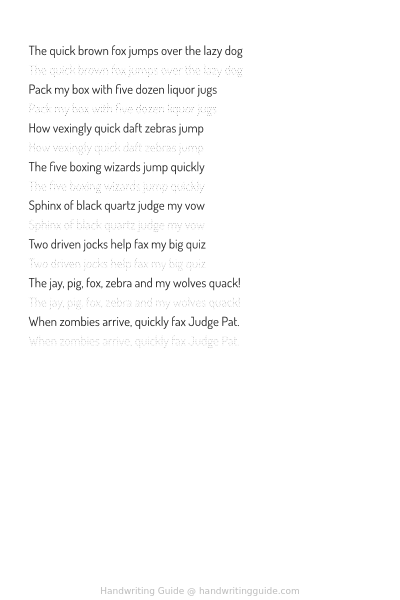
Pangrams written with Dosis font on dot grid. Each pangram is shown in full line followed by dotted tracing row for tracing practice.
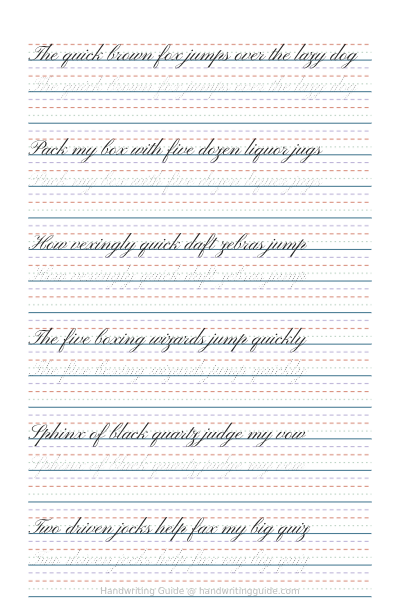
Pinyon Script is a decorative, copperplate-inspired display script with an engraved-stationery feel. Rows for copying and tracing.
Print-ready sheets for classroom use: alphabets, copywork and whole-class sets, organised by level and curriculum style.
// classroom ready → 07.2Minimal layouts, 5 mm dot grid sheets, header styles and lettering practice, all made for neater spreads.
// dot grid & lettering →Found a style you like? Turn it into a practice sheet.
Any font, any text, PDF in seconds.Grip, posture, letter formation, and the daily habits that separate consistent writers from occasional ones.
→ // cursiveA practical path from first stroke to fluent cursive: letter families, joins, building speed, and everything in between.
→ // fontsFrom simple print fonts for young learners to minimalist styles for bullet journaling. How to choose the right model for your practice sheets.
→ // common problemsMost handwriting problems share a handful of root causes. How to identify and address yours.
→ // exercisesWarm-ups, line drills, shape drills and letter drills for better pen control and letter consistency.
→ // stylesSpeed, readability, and learning curve compared, and which style actually suits your needs.
→ // cursiveThe four join patterns that cover the whole alphabet, the letters that behave badly, and a practice sequence that builds them in order.
→ // curriculaD'Nealian, Zaner-Bloser, Getty-Dubay, Handwriting Without Tears and the British schemes: an honest comparison for classrooms and homeschools.
→ // eslHow English differs from Arabic, Chinese, Cyrillic and other scripts, and where the real retraining lies for each background.
→Most people see noticeable improvement within two to four weeks of daily ten-to-fifteen-minute sessions. Significant, lasting change typically takes three to six months. The key variable is consistency, not duration per session.
Read the full improvement guide →Print first. Cursive builds on the letterforms established in print, so shaky print means shaky cursive. Once each printed letter is consistent and fluent, the transition to joined writing is much faster.
Print vs cursive, compared →Yes. Every ready-made worksheet and every sheet you generate is free to download and print. No account, no watermark, no locked features. Print as many as you like, for home or classroom use.
Browse the worksheet catalog →Yes. Adults often improve faster than children because they understand the goal and can self-correct consciously. The challenge is unlearning ingrained habits rather than forming new ones from scratch.
Why handwriting gets messy, and how to fix it →The font is your model: every letter shape you practise will drift toward it over time. Choose one that represents the style you actually want in your own hand, and stick with it until your letterforms are consistent.
How to choose a practice font →Practise Arabic letterforms with contextual shaping, a full alphabet mode, and featured calligraphic fonts.
// right-to-left → 10.2Practise the Persian alphabet in Naskh and Nastaliq styles, with full contextual joins and word banks.
// right-to-left → 10.3Practise Urdu in Nastaliq script (the traditional calligraphic hand for Urdu) with shaped letter-form and word modes.
// right-to-left → 10.4Practise vowels, consonants and barakhadi syllable grids with HarfBuzz shaping and featured Devanagari fonts.
// devanagari script → 10.5Hiragana, katakana and kanji copywork in genkouyoushi grid cells, with romaji transliteration labels in the margin.
// hiragana · katakana → 10.6Practise Hangul syllable blocks in grid cells, with Revised Romanization labels and full KS X 1001 syllable coverage.
// hangul → 10.7Practise the Russian alphabet (capitals, lowercase, common words and copywork) with pronunciation labels in the margin.
// cyrillic script → 10.8Practise the Greek alphabet (capitals, lowercase, common words and copywork) with letter names in the margin.
// greek script → 10.9Practise the Hebrew alphabet, final (sofit) letters, common words and copywork, written right to left, with letter names in the margin.
// right-to-left →No account. No cost. Just choose a font, enter your text, and print. Come back whenever you need to practise.